Where the Dust Actually Comes From
Dust on a shelf of paper is rarely just dust. Notes on what breaks down, what sheds, and what to keep off the same shelf as your archive.
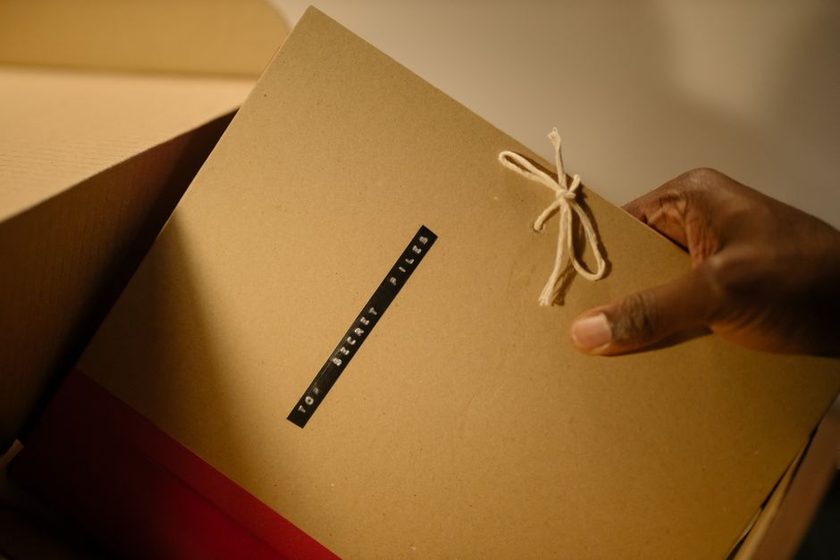
Pull an old shoebox down from a closet shelf and tip it toward the light, and you will usually see it: a fine gray-brown film along the underside of the lid, gathered thick in the crease where a rubber band used to sit, dusted across the top folder like a shadow. Most people call this dust and leave it there. But dust that collects specifically around stored paper is rarely one uniform substance. It is a small, local mixture — fragments of the box itself, the fasteners inside it, and sometimes the paper — all breaking down together in the same few inches of still air.
It's Rarely Just Dust
Household dust in general is mostly skin cells, textile lint, and outdoor particulate that drifts in through doors and windows. Shelf dust behaves differently, because it forms in a mostly closed space where a handful of specific materials sit aging next to each other for years without being disturbed. Open a bin that has sat untouched since a move, and what has accumulated is closer to a residue than to dust in the ordinary sense — a slow settling of whatever nearby object could not hold its own shape. A steel paperclip sheds oxidized flakes. A rubber band perishes into something closer to tar, which eventually dries and crumbles. A cardboard corner softens and sifts down as fiber. Paper, when it is acid-free and left alone, is often the most stable thing in the box — which is a strange thing to notice the first time you actually look closely.
The Paper Itself Sheds First
That said, paper is not immune. Wood-pulp paper — most notebooks, most printed forms, most newsprint — contains lignin, and lignin keeps breaking down slowly for as long as the sheet exists, releasing acids that make the paper more brittle with each passing year. Handle a decades-old folder of that kind of paper and you will feel a light grit on your fingers afterward; that grit is cellulose fiber that has already separated from the sheet, waiting for a hand or a draft of air to carry it off. Cotton rag paper and true archival stock shed far less, because they were never built from the same short, acid-heavy fibers to begin with. This is part of why the paper that survives a closet for seven years without much attention often isn't the paper that looked sturdiest going in — it's whatever had the fewest impurities from the start.
What the Fasteners Leave Behind
Most of what collects near a folder, though, didn't come from the paper at all — it came from whatever was holding the paper together. Steel paperclips and staples rust from the inside out long before they look rusted on the surface, and the fine reddish-brown powder that results migrates onto the page beneath it, leaving both a stain and a residue that can be brushed away but never fully removed. Rubber bands are worse. They perish — the actual term for what natural rubber does as it ages — into a dark, sticky substance that eventually hardens and flakes, and by then it has usually bonded lightly to whatever paper it was wrapped around.
Field note
A fine reddish-brown grit near a folder's fastener corner is almost always oxidized steel, not outside dirt — the paperclip or staple rusting quietly for years before the color ever reaches the surface you can see.
Cardboard Does More Damage Than the Paper Inside It
The container is frequently the least stable thing in the whole arrangement. Corrugated cardboard is made from the same lignin-heavy pulp as cheap paper, packed with more surface area and more exposed edges, and it responds to humidity swings by expanding and contracting at its corners until they simply crumble. A box that has been nested inside another box for a decade will often show more decay than anything stored inside it — the outer layer sacrificing itself first, almost as if by design. This is one of the quieter arguments for a plain manila folder over a cardboard file box for anything meant to last: the folder has less material to break down, and less of it touching the paper directly. It's a small material choice, but the drawer it goes in ends up mattering more than most people expect.
A Few Separation Habits That Slow It
None of this is reversible once it has started, but the rate of it is mostly a matter of what is touching what. A few habits, none of them elaborate, seem to make a real difference over years rather than months:
- Pull metal fasteners before a folder goes into long-term storage, rather than after damage has already shown.
- Keep cardboard boxes and fabric-covered items on a separate shelf from paper, not stacked directly against it.
- Wipe a shelf's front edge every season or two, before residue has a chance to migrate onto a folder's spine.
- If a stack needs to hold its shape, use a strip of acid-free tape or a clip-free wrapper instead of a rubber band.
| Source | What you'll notice | Why it happens | What helps |
|---|---|---|---|
| Rusting clips & staples | Reddish-brown grit, faint staining | Steel oxidizes slowly from moisture in the air | Remove before long-term storage |
| Perished rubber bands | Dark sticky residue, later a dry crumb | Natural rubber breaks down with age and light | Swap for acid-free tape |
| Cardboard box corners | Fine tan fiber, soft crumbling edges | Lignin-heavy pulp reacts to humidity swings | Plain folder, separate shelf from paper |
| Old wood-pulp paper | Light grit after handling, yellowing | Acid in the paper keeps degrading it slowly | Handle less, store flat and undisturbed |
| Fabric or foam liners | Fine lint, faint synthetic smell | Foam and dye breaking down over time | Keep textiles off the paper shelf entirely |
The dust on a shelf of paper is rarely a mystery once you look closely — it is a record of everything nearby that could not hold together as well as the paper did.
None of this calls for anything dramatic. It mostly calls for noticing, once, what is actually sitting next to what — and moving the things that are breaking down away from the things you'd rather keep.
These are general household observations about how ordinary materials age near one another, not conservation guidance for rare, valuable, or already-damaged documents. If something on your shelf has real historical or monetary significance, a paper conservator can assess it properly — this is a household record, not a museum one.